

Valuing New Zealand’s ecosystem services: evidence and guidance to support decision-making
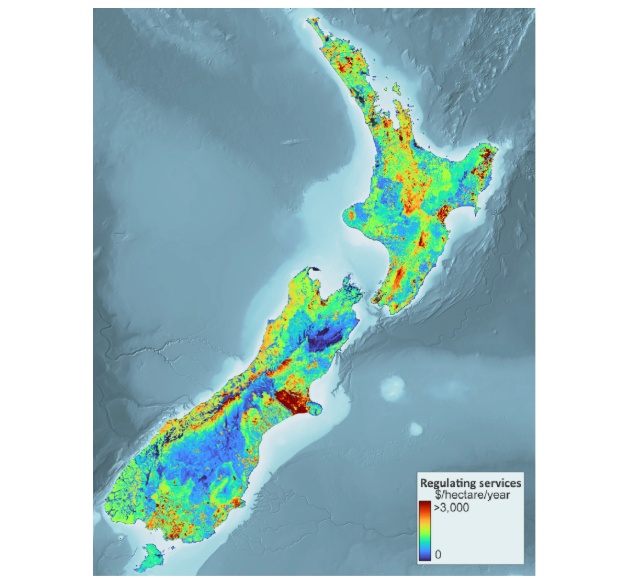
The combined estimated value of assessed regulating ecosystem services across New Zealand. This map reflects the spatial distribution of the annual value of ecosystem processes that regulate environmental conditions and reduce damage costs to people and economic activity.
The Parliamentary Commissioner for the Environment (PCE) has engaged Concept Consulting to develop a set of monetary values for New Zealand’s ecosystem services. These values can be used to support decision-making through their inclusion in cost-benefit analysis and other project evaluation tools.
New Zealand's ecosystems provide benefits that support our wellbeing and economy – from carbon storage and water purification to flood mitigation, recreation and food production. However, because these benefits are not easily expressed in monetary terms, they are difficult to account for in policy and investment decisions. The Valuing New Zealand's Ecosystem Services project helps address this challenge by developing monetary values for ecosystem services and making them available to environmental managers, policy analysts and spatial planners.
Background to the work
This work stems from the Commissioner’s 2021 report, Wellbeing Budgets and the environment: A promised land? The report examined how environmental considerations had been integrated into the Treasury’s budget process. A key finding was that an absence of monetary values can lead to the environment being assigned an implicit zero economic value. This results in the environment being underweighted in decision-making processes.
Recent changes to New Zealand’s environmental policy settings (such as the Fast-track Approvals Act 2024) have highlighted the need for information to assess trade-offs. Ecosystem service values can be used to evaluate trade-offs between different dimensions of the environment and between environmental and economic objectives. They can also provide part of the necessary evidence base to determine whether projects and policy initiatives represent value for money.
New Zealand’s current evidence base with respect to ecosystem service values is lacking. The Treasury’s cost-benefit analysis model (CBAx) provides the most accessible range of ecosystem service values but is limited in scope and coverage. The last comprehensive assessment of the value of New Zealand’s ecosystem services was undertaken by Patterson and Cole and released in 2013. There is a need for an expanded and updated set of ecosystem service values to support decision-making processes.
The project
This project provides updated monetary values for a range of provisioning, cultural and regulating ecosystem services in a spatially explicit framework. The results can be used to provide an indication of the scale of benefits that ecosystems provide and trade-offs that may arise if land use or environmental conditions change. The values are intended to support screening, prioritisation and scoping rather than detailed site-specific assessments.
The results are experimental in nature with monetary values based on the best available environmental and economic data. The work has been designed to ensure the method is transparent and can be updated to incorporate methodological refinements and data updates. Any feedback or suggestions that could help further develop and improve this work can be directed to pce@pce.parliament.nz.
This work represents an important advancement in the valuation of New Zealand’s ecosystem services, and provides a foundation for future research to ensure a robust and enduring approach. The office encourages government departments and research agencies to invest in the identified research priorities so that these estimates can be improved over time.
Considerations for interpretation and application
The PCE recognises that environmental valuation has its limitations and controversies. The values presented here should be regarded as only one input to any public policy process and should be complemented by other information and decision-support tools. Practitioners should exercise the necessary care, skill and judgement when applying these values. For example, these values should not be used to assess trade-offs between rare, scarce or naturally uncommon ecosystems. Nor should they be used to create an estimate of the total value of New Zealand’s natural capital.
This work does not extend to the monetisation of broader spiritual, cultural or Māori values as monetisation of these values is generally considered inappropriate. See the related resources on this webpage for more information on te ao Māori conceptions of wellbeing and relationships with the environment.
Project outputs
Project outputs include:
- Guidance for policy practitioners in the form of summary valuation results and illustrative case studies
- Technical documentation relating to method and limitations to enable informed and appropriate application.
- Selected geospatial layers hosted on the MfE Data Service by the Ministry for Cities, Environment, Regions and Transport.
- Additional geospatial layers and source code, which are available on GitHub.
The PCE would like to acknowledge the contributions from many agencies and individuals to the development and presentation of this work.
- Read the commissioned guidance report.
- Read the technical documentation.
- View the summary tables.
Open-source data
- MfE Data Service: Provisioning ecosystem service layers.
- MfE Data Service: Regulating ecosystem service layers.
- MfE Data Service: Cultural ecosystem service layers.
- GitHub: Ecosystem Services 2026.